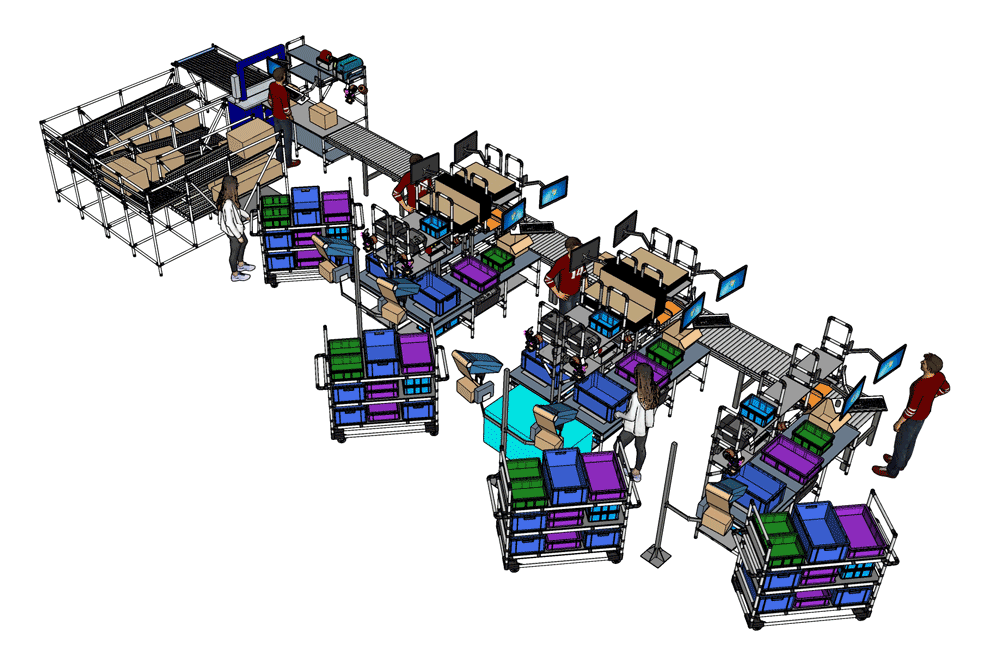
Packing workstations are among the stations where ergonomic effects are particularly visible. This is where material flow, variants, documentation and physical labour come into direct contact. Whether a packing process runs smoothly, reproducibly and economically rarely depends on the actual packing, but rather on how clearly the transfers, heights and processes are structured. Packing stations are therefore an ideal test point for ergonomic process design: they quickly show whether a system is flowing - or whether employees have to compensate.
Transfer heights - ergonomics start in front of the packing table
The ergonomic design of a packing station is often decided before the first movement. Feeders that are too low, unclear positions for cardboard packaging or changing transfer points lead to employees developing compensatory movements - and these add up over the course of the day. Ergonomic handovers are therefore not a „convenience“, but a prerequisite for stable processes.
A practical example: In a spare parts area, the changeover from carton provision close to the floor to a raised feed tray resulted in significantly fewer turning and lifting movements. The cycle time remained almost identical, but the variation decreased - a typical pattern when ergonomic transfers take effect.
We are familiar with similar situations from our projects: As soon as cardboard packaging or filling material is provided at a clear height with a defined stop, many unsteady movements that were previously not perceived as ergonomic stress but as „necessary“ disappear.
Work surfaces - variable, not arbitrary
Packing processes alternate between visual work, gripping work and pressure work. A single fixed working height inevitably leads to ergonomic compromises because activities have different requirements. It makes sense to have a surface that offers several functional zones and supports natural movement patterns.
In practice, two levels are often sufficient - a work surface in the ergonomic gripping area and a second level slightly above or below for preparation or sealing work. This clear division of functions reduces interruptions because the movements do not have to constantly switch from fine motorised to force-based.
Material flow - order creates calm
Packing processes often lose their rhythm when material arrives irregularly or there is no clear supply logic. Ergonomic packing stations therefore work with defined primary gripping zones, clear feed points and unambiguous return points.
An example: In a NeoLog application in the dispatch area, the end height of a roller conveyor was adapted to the gripping zone. The small forward bending movement previously required was eliminated - and although the time gain was small, the process became smoother and more homogeneous. Employees later confirmed that the work seemed „less torn“. It is precisely such structural effects that make ergonomic packing stations economical.
Cognitive ergonomics - orientation instead of searching
Packing stations are often tightly packed. If labels, documents, scanners or padding material are not clearly positioned, the mental strain increases. Searching movements are ergonomically relevant - they are physical movements, only triggered by a lack of orientation.
Ergonomic packing stations reduce these search moments by creating clear lines of sight, logically organising trays and guiding variants neutrally. Several projects have shown that simply arranging label rolls horizontally (instead of stacked) reduces error rates because the hand finds the right starting point without having to make mental detours.
Filling and upholstery material - ergonomic handling of volume
Filling material is one of the most frequent disruptive factors in packaging processes. It creates lateral movements, uncontrolled pulling directions and often improvised deposits. Ergonomic systems ideally feed filling material from above or within the gripping area, eliminating large arcs of movement.
In peak situations, we have observed that the repositioning of filling material in the immediate vicinity of the gripper significantly reduces fatigue - especially when lateral or ground-level pulling movements were previously required.
Ergonomics in detail - scanners, labels, documents
Most ergonomic effects are not achieved through major redesigns, but through small, precisely placed points: Scanners in the reach-in area instead of above shoulder height, label dispensers slightly diagonal in the grip tape, documents on the eye line instead of in stacks, waste bins not on the floor. Such details are used hundreds of times per shift. Every unnecessary movement is multiplied.
Practical impulses - directly realisable
- Standardise feed and transfer heights
- Organise work surfaces into functional zones
- Hold the filling material in the primary gripping area
- Align labels, adhesive tape, scanner logically
- Consistently reduce redundant storage
- Clear positions for return containers
- Systematically shorten grip distances
- Guide variants through unique places
Conclusion
Packing workstations show very clearly how closely ergonomics and process quality are linked. When transfers, heights and gripping zones are structured, the result is a process that is not faster, but more stable - and it is precisely this stability that reduces stress and costs. Our experience from projects confirms that packing stations are one of the areas in which ergonomic measures have a particularly rapid impact: Not because more output is generated, but because the processes become repeatable and physical compensation is eliminated.