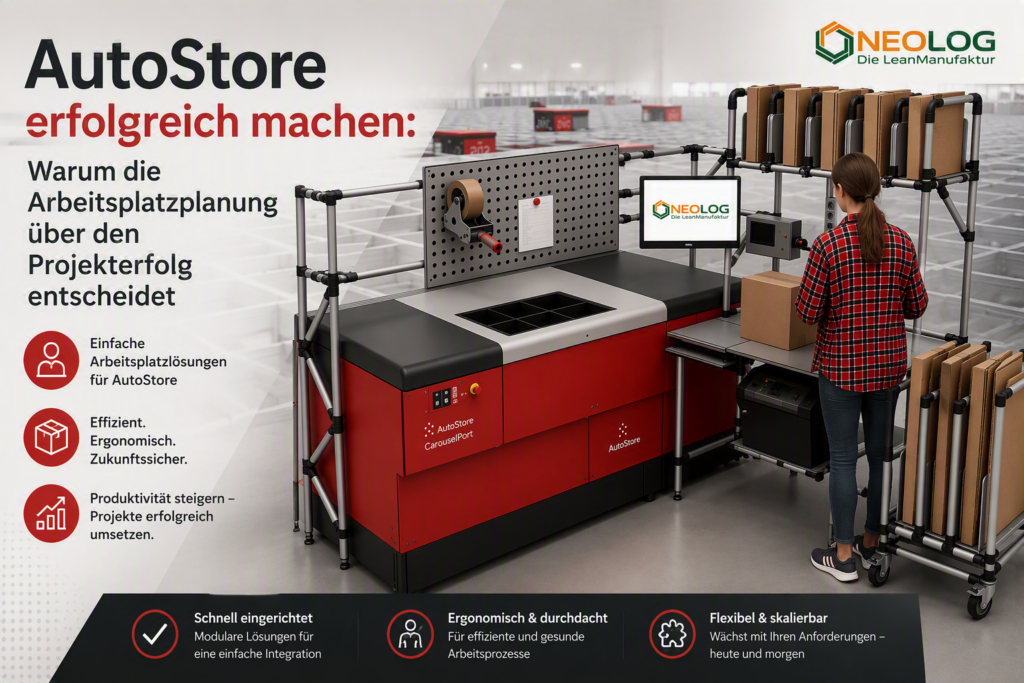

Mobile workstation systems play a bigger role in modern intralogistics processes than it seems at first glance. While stationary workstations are clearly designed according to ergonomic criteria, mobile modules such as trolleys, flow racks or movable material stations often remain in the background. Yet this is precisely where a significant part of the ergonomic effect unfolds - where material is actually moved, supplied or restructured at short notice.
Daily practice shows that ergonomics does not end at the permanently installed packing table or assembly station. It arises wherever movements take place, transfers are made and material flows vary. Mobile workstation systems are therefore not complementary, but an integral part of an ergonomically stable process design.
Mobile systems as part of an overall ergonomic system
A workstation can be very well designed ergonomically - the heights, reach spaces and shelves are just right. But as soon as the supply does not fit into this rhythm, disruptions occur. This is precisely where mobile modules come in: They combine physical ergonomics with material flow and process logic. It is not the person who goes to the resource, but the resource that comes to its ergonomic area in a controlled manner.
Typical ergonomic effects of mobile systems:
- More stable gripping paths despite changing material sizes
- Fewer interruptions in the process
- Less mental stress thanks to clear structures
- More compact movement patterns at high frequency
- Flexible transfer zones, especially for variant changes
Mobile modules therefore have a direct process-stabilising effect - and this process stability is an ergonomic effect.
Material flow as an ergonomic factor
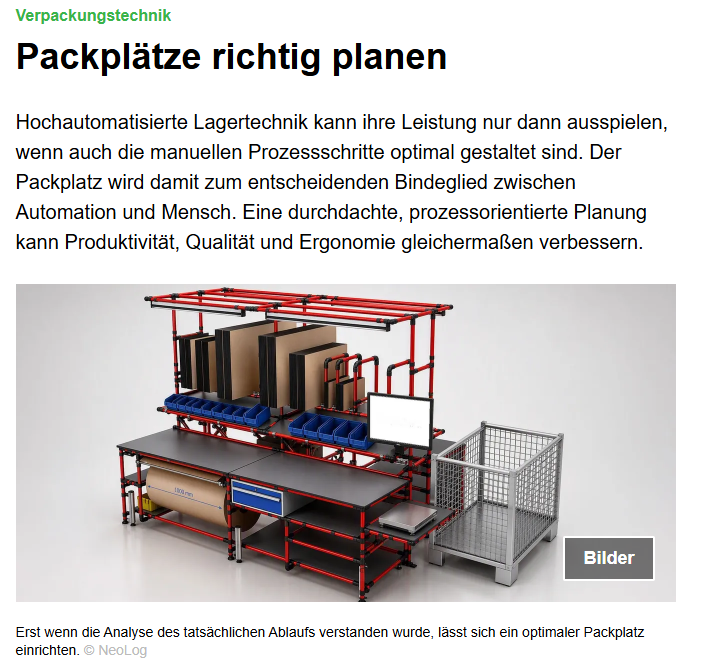
Packing processes alternate between visual work, gripping work and pressure work. A single fixed working height inevitably leads to ergonomic compromises because activities have different requirements. It makes sense to have a surface that offers several functional zones and supports natural movement patterns.
In practice, two levels are often sufficient - a work surface in the ergonomic gripping area and a second level slightly above or below for preparation or sealing work. This clear division of functions reduces interruptions because the movements do not have to constantly switch from fine motorised to force-based.
Material flow - order creates calm
An order picking station or packing table only works smoothly if material arrives at the correct height, in the correct sequence and in the correct position. Many ergonomic strains are not caused by heavy loads, but by unclear material paths.
Example from practice:
In an automotive aftermarket project, employees had to park KLTs to the side because the fixed storage area did not fit the component sorting system. A mobile trolley, adapted to the primary gripping area, completely eliminated these evasive movements. The cycle time hardly changed at all - but the variation decreased significantly. The typical pattern: the process becomes smoother.
The material flow therefore determines whether movements remain consistent or whether employees have to compensate. Mobile systems make this consistency possible in the first place.
Gripping spaces and reach ranges - mobile systems as an ergonomic buffer
In areas with a high number of variants or fluctuating container sizes, fixed workstation dimensions quickly reach their limits. Mobile systems make it possible to dynamically adapt gripping spaces without having to reconfigure the workstation.
Example:
In spare parts logistics, varying KLT heights were previously removed from the knee zone. A height-adjustable mobile trolley made it possible to remove items from a constant gripping range - regardless of the product mix. The ergonomic advantage lay less in the reduction in force than in the repeatability of the movement.
These micro-effects are particularly measurable in high-frequency ranges with 400-800 picks per layer.
Height logic - why mobile modules smooth out transfers
Transfer points are among the most ergonomically sensitive points in a process. Material that arrives too low, too high or too far back creates unsteady movements. If the height, inclination and position of mobile modules are defined, many of these stresses disappear.
Example from a NeoLog project in mechanical engineering:
A mobile throughfeed module was adapted so that the final height of the roller conveyor was precisely aligned with the gripping area. The slight forward bending movement previously required was no longer necessary. The cycle time remained unchanged - but the smoothness of movement was clearly noticeable.
Height logic is therefore not a fixed measure, but a dynamic component of ergonomic process control.
Mobile systems make processes resilient
One advantage of mobile workstation modules is often underestimated: they absorb fluctuations. Variant changes, seasonal peaks, temporary bottlenecks or reorganisations can be structurally managed with mobile units without changing the stations themselves.
Typical use cases:
- Picking islands that can be expanded or reduced depending on the order situation
- Mobile FIFO systems for equalising peak loads
- Assembly lines that require additional transfer points when changing variants
- Packing areas that run different processes depending on the season
- Flexible supply trolleys between several stations
Mobile systems therefore not only increase ergonomic quality, but also versatility - a key economic aspect.
Dynamics in the picking process - ergonomics under frequency
Many strains are not caused by heavy work, but by the high repetition frequency of gripping, depositing and scanning. Mobile systems act as a cycle stabiliser here.
Typical ergonomic effects:
- Clear axis of movement → fewer micro-rotations
- Defined storage points → fewer search movements
- Mobile container levels → no alternative steps
- Constant final height → less shoulder work
These effects are small, but they have a direct impact on the error rate, fatigue and process quality.
Practical recommendations for mobile workstation systems
- Harmonise transfer and end heights between stationary and mobile modules
- Orient mobile shelving to the most common reach paths
- Feed large-volume containers from the front instead of the side
- Clearly separated zones for primary and secondary material
- Guide container movements along the axis of movement wherever possible
- Adapt castor quality to floor conditions
- Plan mobile units as an integral part of the process - not as accessories
Conclusion
Mobile workstation systems are a key element of modern ergonomics. They are effective where processes vary, materials change and movements occur. Thanks to clearly defined gripping zones, structured material flows and flexible positioning, they stabilise processes and reduce strain - especially in order picking, assembly and packaging.
Many projects have shown that mobile modules do not make processes faster, but calmer. And it is precisely this process calmness that has the strongest ergonomic effect.